| Category | Ideas |
|---|---|
| Website Features |
|
| Food Assistance |
|
| Housing |
|
| Healthcare |
|
| Employment |
|
| Creative Ideas |
|
The target audience is low-income individuals and families who struggle to afford basic necessities such as food, housing, healthcare, and education. A typical user may be a single parent searching for food assistance and affordable housing while trying to support their family.
Their main motivation is to achieve financial stability, security, and peace of mind by quickly finding reliable community resources.
They currently search multiple websites, visit food banks, contact community organizations, and ask friends or family for assistance.
Most users feel stressed, frustrated, and anxious because finding help is often confusing and time-consuming.
My research confirmed my initial assumption that people struggle to find resources, but I also learned that outdated information and searching multiple websites are major challenges.
Find food, housing, healthcare, education, and employment resources quickly.
Provide for themselves and their families while maintaining dignity and independence.
Feel secure, confident, and less stressed after finding the help they need.
Users would hire the Community Resource Hub and stop relying on searching multiple websites or making several phone calls.
The biggest barrier is finding reliable and up-to-date information in one place.
Users worry they may waste time or not qualify for assistance.
Without change, people may continue struggling to meet their basic needs and experience ongoing financial hardship.
Many people spend hours searching different websites or repeatedly contacting organizations to find available assistance.
Users can quickly find the help they need in one place without unnecessary stress.
An AI chatbot recommends nearby resources based on the user's needs and location.
Success is measured by how quickly users find resources and receive assistance.
Our solution makes users faster by providing all community resources in one easy-to-use platform.
We are the only community resource website that brings food, housing, healthcare, education, and job opportunities together in one place for low-income individuals and families because we organize trusted local resources into one simple platform.
We focus on providing reliable community resources instead of offering every possible service online.
Our searchable resource directory allows users to quickly find local services based on their needs.
We help people find the support they need without wasting time searching many different websites.
Our Community Resource Hub helps low-income individuals and families quickly find trusted food, housing, healthcare, education, and employment resources in one place, reducing stress and saving time while improving access to the support they need.
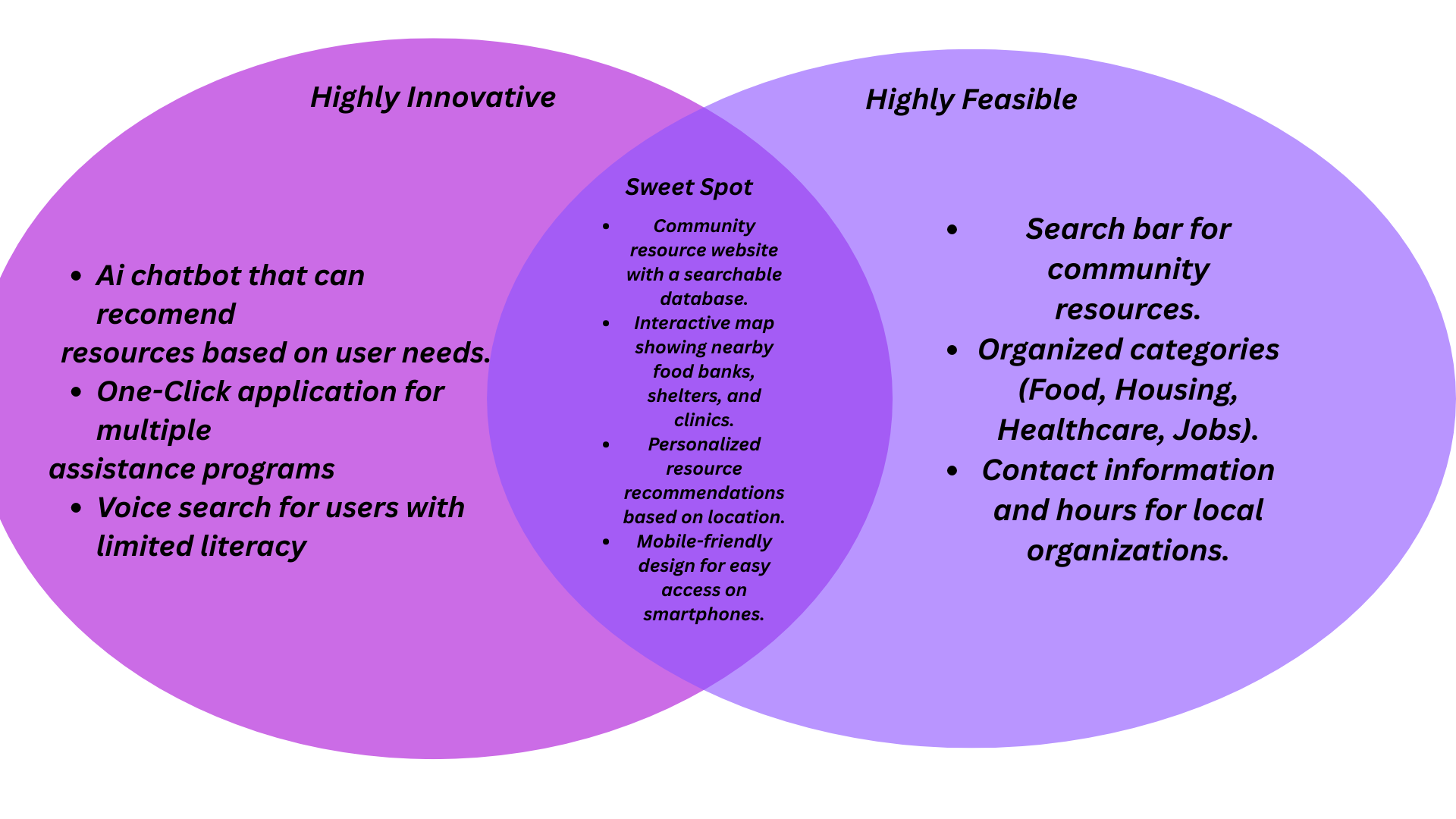
I selected these ideas because they provide the best balance of innovation and feasibility. A searchable community resource website, interactive map, and mobile-friendly design are realistic to build and would immediately help users find the support they need. The AI chatbot and personalized recommendations add an innovative element by making it easier for users to discover relevant resources quickly. Together, these features create a practical solution that reduces stress, saves time, and improves access to food, housing, healthcare, education, and employment resources.